The most important activity of a bank is to mobilize deposits from the public. People who have surplus income and savings find it convenient to deposit the amount with the bank.
1) Demand Deposits- Account holders can withdraw money any time and on demand.
2) Term Deposits- Deposits are repayable with interest only after the maturity period.
TYPES OF DEMAND DEPOSITS.
1) Current Account.
2) Savings Account.
TYPES OF TERM DEPOSITS.
1) Fixed Deposit.
2) Recurring Deposits.
FIXED DEPOSIT.
- The principle with interest is returned after a definite maturity.
- Interest rates are high.
- Minimum Duration- 7 days.
- Maximum Duration- 10 years.
- Minimum Amount- Rs 1000.
RECURRING DEPOSIT.
- The money is deposited in installments for a definite period of time. After the maturity period the deposited money with interest is returned back.
- Minimum installment- Rs100.
- Term- 1 to 10years.
GRANTING ADVANCES
The second primary function of commercial bank is to grant loans and advances. Such loans and advances are given to the members of the public and to the business community at a higher rate of interest than allowed by banks on various deposit accounts.
The difference between the rate rate of interest allowed on deposits and the rate charged on loans is the main source of bank's income called the Net Interest Income.
TYPES OF LOANS.
1. Demand Loans.
a) Gold Loan.
b) Crop Loan.
2. Term Loans.
a) Home Loan- Period- 15yrs, 20yrs, 25yrs, 30yrs.
b) Vehicle Loan- Period- 7yrs.
c) Personal Loan.
Secured Loan.
A loan with collateral is called a Secured Loan. i.e. the borrower pledges a property or other assets to the creditor and states that the creditor may take ownership of the property if the borrower defaults on the loan.
Eg: Mortgage Loan, Car Loan, Home Loan, Loan against property, Gold Loan, Crop Loan etc.
Unsecured Loan.
A loan that is not secured by ab asset or lien.
Eg: Personal Loan, Credit Card Loan, Bank Overdraft, Education Loan etc.
SECONDARY FUNCTIONS
1. Letter of Credit.
2. Bank Guarantee.
3. Travelers Cheque.
4. Vaults or Locker facility.
5. Foreign Exchange.
6. Fund Transfer.
7. Issuing Demand Draft and Pay Order.
LETTER OF CREDIT
A Letter of Credit is a document issued by a financial institution, assuring payment to a seller of goods and services provided certain documents have been presented to the bank.
These are documents that prove that the seller has performed the duties under an underlying contract (eg. sale of goods contract) and the goods/services have been supplied as agreed. In return for these documents, the beneficiary(seller) receives payment from the financial institution that issued the letter of credit.

After a contract is concluded between a buyer and a seller, the buyer's bank supplies a letter of credit to the seller.
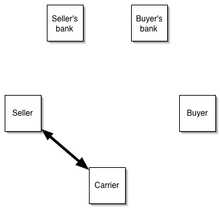
Seller consigns the goods to a carrier in exchange for a
bill of lading.
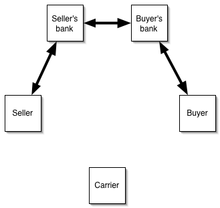
Seller provides
bill of lading
to bank in exchange for payment. Seller's bank exchanges bill of lading
for payment from buyer's bank. Buyer's bank exchanges bill of lading
for payment from the buyer.

BANK GUARANTEE
Bank guarantee is a guarantee from a lending institution ensuring that the liabilities of a debtor will be met if the debtor fails to settle a debt.
For example, if an Indian Company wants to import machines from USA. The importer pledges a physical asset in the Bank and the Bank will issue a Bank Guarantee of certain amount subject to certain conditions which is given to the seller. In the event if the buyer does'nt pay the money the bank will take over the asset and make the payment.
TRAVELER'S CHEQUE
A Traveler's Cheque is issued by a financial institution that can be used as a medium of exchange in place of hard currency. Traveler's Cheque are often used by individuals who are traveling on vacation to foreign countries. Traveler's cheque provide a safe way to carry currency.
Traveler's Cheque is issued in variety of monetary denominations such as the US Dollar, Euro, Japanese Yen, Canadian Dollar, Australian Dollar and British Pound.


 Posts
Posts


